

The Treasury Department has issued new rules for the Education Freedom Tax Credit (EFTC), the federal scholarship tax credit that takes effect January 1, 2027. The rules answer several questions that matter to schools, families, and donors. Here is what you need to know:
No marriage penalty
The tax credit is worth up to $1,700 for an individual donor and $3,400 for married couples filing jointly.
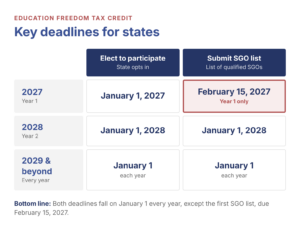
Key deadlines for states
In order for scholarships to be awarded in a state, that state has to both elect to participate, and submit a list of qualified SGOs, each year.
States Cannot Discriminate Against Qualified SGOs
A State may not require SGOs to operate in a manner that is more restrictive than the requirements set forth in section 25F(c)(5) and § 1.25F–3(b) and (c), such as by limiting the type of school that scholarship recipients may attend or the types of qualified elementary or secondary education expenses for which scholarship funds may be used.
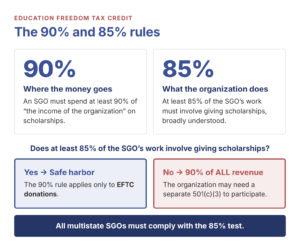
The 90% and 85% rules
The law requires each SGO to spend at least 90% of the income of the organization on scholarships. An SGO has through the following calendar year to spend a donation.
- If at least 85% of the SGO’s work involves scholarships: the 90% rule applies only to EFTC donations.
- If not: the SGO must spend 90% of its total revenue on EFTC scholarships.
Student eligibility
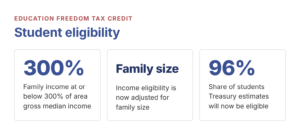
- Stricter criteria allowed: an SGO can set tighter limits, such as serving only low-income students.
- State residents only: an SGO can only provide scholarships to residents of its state, with exceptions for military families and those on tribal lands.
- Not taxable: scholarships are not taxable income for families.
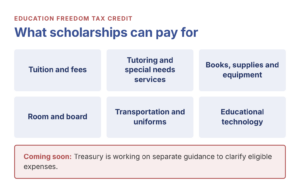
What scholarships can pay for
What comes next
The first deadline arrives January 1, 2027, when the tax credit goes live. We will share updates as states announce their decisions and as Treasury issues further guidance.